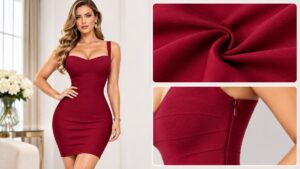
Two bandage dresses can share the same sketch, the same neckline, and the same hem length — and one can cost nearly twice the other.
The reason is not the label, the trim, or the factory location.
The reason is GSM, and most buyers never ask for the number.
GSM, or grams per square meter, is the finished mass of one square meter of bandage dress fabric after heat-setting.
It is a weighable, verifiable number — not a hanger impression or a photo judgment.
When a 200 gsm knit and a 360 gsm knit share the same silhouette, the heavier one carries roughly twice the yarn, more knitting time, and a heavier dye and finish load.
Those three cost layers stack toward a near-double FOB before a single trim is added.
Buyers should request the finished GSM number on every sample and verify it with a 10 cm × 10 cm swatch weigh-up before comparing quotes.
Understanding what GSM measures, why it moves price, and why photos hide the difference is the practical knowledge that separates a confident sourcing decision from a 2x price surprise.
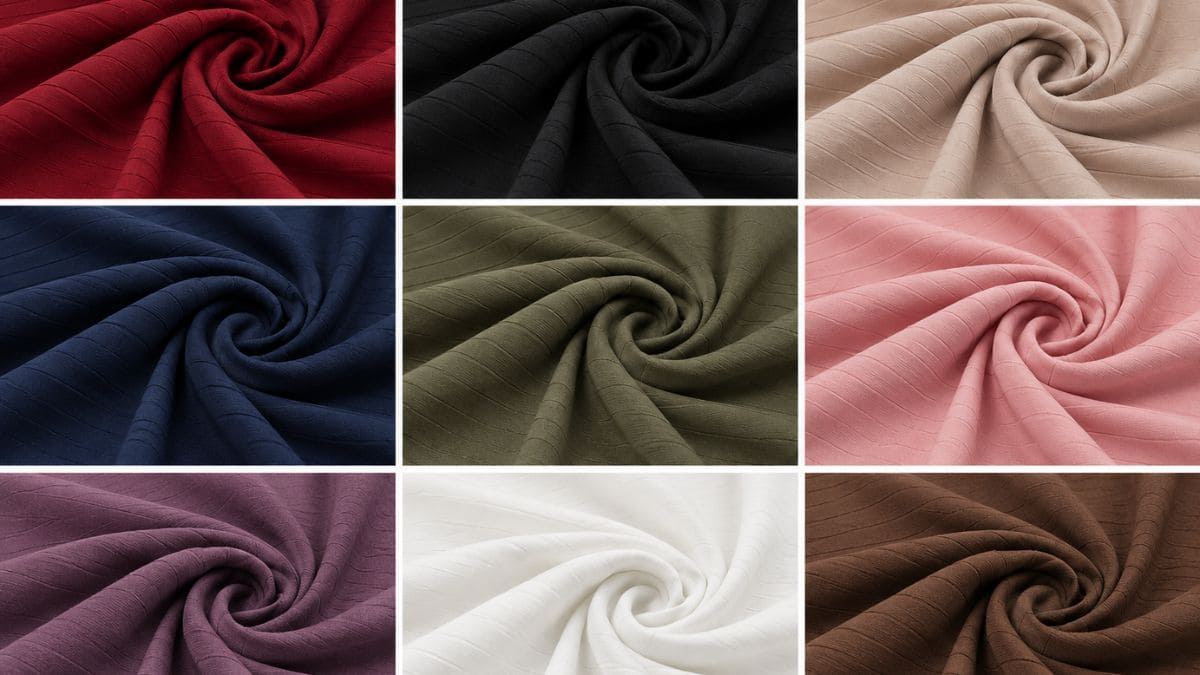
What Does GSM Mean in Bandage Dress Fabric?
Buyers who rely on hanger feel or lookbook photos to judge bandage dress fabric weight are working without a unit.
GSM gives that unit — a single number that describes how much yarn sits in one square meter of finished cloth, and it is the only number that makes price comparisons between lookalike styles meaningful.
GSM in bandage dress fabric is the mass in grams of one square meter of finished, heat-set knit — not a thickness estimate, not a hand-feel description, and not a greige weight.
Two dresses that photograph identically can differ by 100 g/m² or more, and that gap is the price gap.
Buyers should request the finished GSM number in writing on every purchase order and verify it against a physical swatch before bulk production begins.
Confirm the GSM spec on the finished, heat-set cloth — not on the loom state — and include it as a numbered line on the PO before any deposit is paid.
GSM Is Mass Per Square Meter, Not Thickness in a Photo
GSM is a mass measurement, not a visual one, which is why it cannot be read from a product image.
- GSM is grams of finished knit in one square meter of bandage dress fabric, measured after heat-setting — it is the commercial specification the mill sells, not a hanger thickness guess or a tactile impression.
- Two dresses can share a neckline, a hem length, and a color and still differ by 100 g/m² or more; the difference is invisible in a lookbook but fully visible in a cost sheet.
- A thick bandage dress is a high-GSM knit; a thin lookalike is a lighter loop structure with less yarn packed into the same area — the silhouette can be identical while the mass is not.
- Buyers should write GSM on the PO as a specific number — for example, "360 gsm finished, heat-set" — not as "heavy" or "premium hand," which are subjective and unenforceable.
How Finished GSM Is Locked After Heat-Setting
The GSM a buyer pays for is not the GSM on the loom — it is the GSM after the fabric has been heat-set to its commercial specification.
- Heat-setting, in bandage knit finishing, is the process that stabilizes spandex for the perfect stretch, sets the width, and locks the fabric to its sold GSM — greige cloth off the machine is not the commercial product and should not be quoted as such.
- Mills typically run greige fabric approximately 15 g/m² heavier than the finished ticket so that the heat-set cloth lands on specification after width and overfeed adjustments are applied.
- If a supplier quotes greige GSM and ships finished GSM, the buyer is comparing two different numbers — the greige weight will always read heavier, which can make a lighter finished cloth appear to meet spec.
- Always ask for GSM on the finished, heat-set bandage knit that will be cut and sewn, and request a lab test report or a swatch weigh-up to confirm the number before bulk production.
GSM Bands Buyers Meet in Bandage Knits
The table below puts real bandage dress fabric weight bands on one card so "looks the same" can be priced against a number rather than a photo.
| GSM Band | Typical Finished Range | Yarn Mass vs a 200 gsm Baseline | What the Buyer Should Expect in Hand |
|---|---|---|---|
| Thin clubwear-style knit | 180–220 gsm | Baseline (1×) | Light, stretchy, minimal body; may feel papery after one wear |
| Mid commercial bandage knit | 240–300 gsm | ~1.3–1.5× | Moderate body; acceptable for mid-market price points |
| High-end heavy bandage knit | 320–380 gsm | ~1.6–1.9× | Dense, structured feel; holds shape at hip and waist |
| Viscose-route example (Route A) | 360 gsm (75% Viscose / 15% Nylon / 10% Spandex) | ~1.8× | Soft drape with sculpting hold; traditional bandage hand-feel |
| Polyester-blend example (Route B) | 350 gsm (68% Polyester / 10% Viscose / 6% Nylon / 6% Spandex) | ~1.75× | Firmer, more sculptural; better shape retention over repeated wear |
Buyers should request a swatch from the specific GSM band they are quoting and weigh it before accepting a supplier’s verbal confirmation.
Course Length and Loop Density as the Mill Levers for GSM
GSM is not a mystery property of a fiber blend — it is a settable, weighable output of how the knitting machine is programmed.
- Course length, defined as the length of yarn consumed per 100 needles on a circular bandage dress knitting machine, is the primary knitting control for loop density, GSM, and stretch — a shorter course length means more yarn packed into the same width, which raises GSM and produces a denser, heavier cloth.
- Shorter course length increases GSM because each loop is tighter and more yarn sits in a given area; longer course length produces a lighter, more open structure with less mass per square meter.
- Gauge and feed count also influence the final GSM, but the key point for buyers is that GSM is a deliberate, programmable specification — not an accidental outcome — and a mill that cannot state the course length setting for a given GSM ticket cannot reliably reproduce it.
- Write GSM as a number on the PO, confirm it on the finished cloth, and treat any supplier who cannot provide a swatch weigh-up as a sourcing risk.
Once GSM is defined as a measurable spec, the next question is why that number can push a same-look dress toward a near-double FOB.
Why Does Bandage Dress Fabric Weight Dictate Price?
The price gap between a 200 gsm lookalike and a 360 gsm premium bandage knit is not a brand markup or a margin decision — it is a cost stack built from yarn kilograms, knitting minutes, and finishing load.
Each layer is proportional to fabric weight, and they compound.
When GSM doubles on the same marker and size, yarn consumption roughly doubles, knitting time per meter rises, and dye and finish load tracks the added mass — the combined effect can push the material-and-process cost toward 2× before any trim or construction difference is counted.
This is why two quotes on identical sketches can differ by 2× and both be honest: the difference is in the fabric weight ticket, not in the margin.
Buyers comparing FOB prices on lookalike styles should ask for the GSM number before asking for a discount.
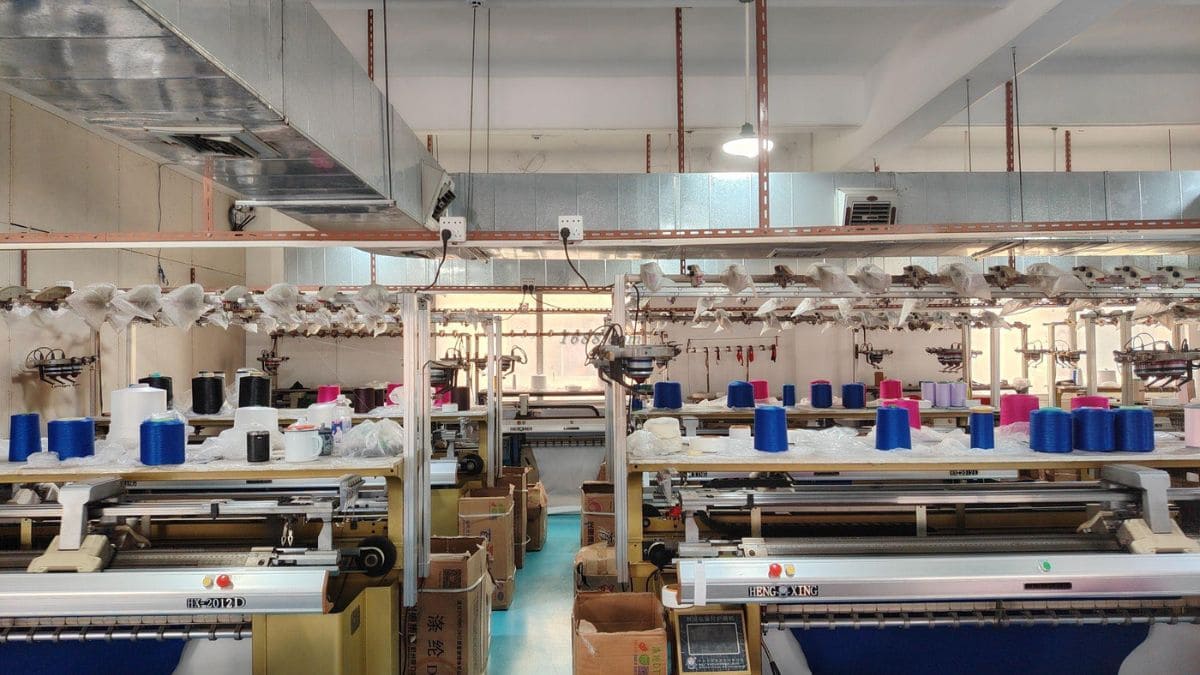
The cost layers below — yarn, knitting time, and finish load — each scale with fabric weight independently.
Buyers who understand all three are better positioned to evaluate whether a 2× price gap reflects a real cost difference or a margin decision.
Before bulk production, request the GSM number in writing and compare it against the FOB quote.
Yarn Kilograms Scale Almost Linearly With GSM
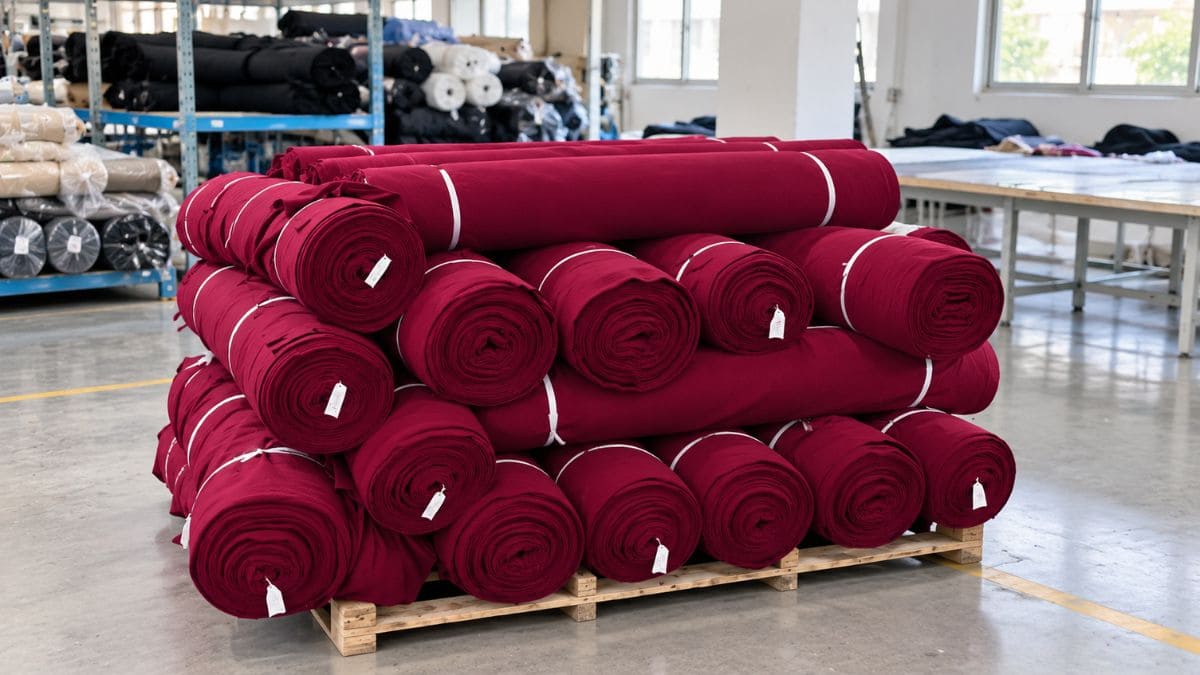
Yarn is typically the largest single cost line on a bandage dress FOB, and GSM sets the yarn quantity before any other variable is considered.
- Same marker, same size, twice the GSM means roughly twice the yarn kilograms in the cut — the relationship is close to linear because the marker area is fixed and GSM directly measures mass per unit area.
- High-end 90% rayon bandage dress programs feel this cost lever most sharply because viscose yarn is the expensive mass in the blend — a viscose-route fabric at 360 gsm carries nearly twice the viscose fiber of a 180–200 gsm alternative, and viscose is priced by weight.
- A dozen dresses at 360 gsm is not "a little nicer" than a dozen at 180–200 gsm; it is close to double the fiber on the cutting floor, which means close to double the yarn cost before the machine is even switched on.
- Yarn is usually the largest line on a bandage FOB, so GSM is the largest quiet price lever — a buyer who negotiates FOB without knowing the GSM is negotiating on incomplete information.
Tighter Course Length Adds Knitting Minutes Per Meter
Denser bandage dress fabric takes longer to produce per meter, and that time cost sits directly on top of the yarn cost.
- A high-GSM bandage knit is not produced at the same machine speed as a lightweight jersey; the shorter course length that raises GSM also means more yarn must be fed per revolution, which reduces output per shift.
- Output per shift falls as GSM rises, so factory minutes per meter of finished cloth increase with the weight ticket — a 360 gsm fabric may require meaningfully more machine time per meter than a 200 gsm alternative on the same equipment.
- That time cost is a real manufacturing cost that sits on top of the yarn kilograms; GSM is not a free upgrade from a lighter cloth, and a supplier who quotes the same FOB for both is either absorbing the cost elsewhere or substituting a lighter fabric.
- Buyers should treat knitting time as a legitimate cost component and expect a higher FOB on heavier cloth, not use the price difference as a negotiating lever without understanding its source.
Heavier Cloth Takes More Dye, Wash, and Heat-Set Load
The finishing chain — dye liquor, wash water, and stenter energy — tracks fabric mass, not the silhouette in a lookbook photo.
- Dye liquor consumption, wash water volume, and stenter energy all scale with the mass of cloth being processed; custom dyeing a 360 gsm bandage dress carries more colorant and requires more finishing minutes than a 220 gsm lookalike cut to the same pattern.
- A high quality bandage dress at 350–360 gsm therefore carries a heavier finish load at every stage of the dyeing and setting chain, and that load is paid for in the FOB whether or not the buyer can see it in a studio shot.
- Heat-setting a heavier elastic knit also requires a stable width-and-GSM recipe — the stenter settings for a 360 gsm cloth differ from those for a 220 gsm cloth, and running the wrong recipe produces a fabric that is off-spec in both weight and dimensional stability.
- Name finish load as a cost component when reviewing quotes; it is not a rounding error on heavy cloth.
Same Look, Near-Double Material Cost
The table below shows how bandage dress fabric weight can double the material-and-process stack even when the sketch, length, and neckline stay identical.
| Cost Driver | Lower-GSM Lookalike (~200–240 gsm) | Higher-GSM Bandage Knit (~360–400 gsm) | Why the Ticket Can Approach 2× |
|---|---|---|---|
| Yarn kilograms per dozen | Baseline (1×) | ~1.7–2× | GSM directly sets yarn mass per marker area |
| Knitting minutes per meter | Baseline (1×) | ~1.3–1.6× | Shorter course length reduces output per shift |
| Dye and finish load | Baseline (1×) | ~1.6–1.9× | Dye liquor and stenter energy track fabric mass |
| Finished piece weight | ~180–220 g per garment | ~320–400 g per garment | Heavier piece = more material cost per unit |
| Illustrative FOB index (yarn + knit only) | 100 | ~170–200 | Combined yarn and time cost before trim or construction |
The FOB index row is illustrative, not a quoted price — actual FOB depends on fiber blend, order volume, and factory overhead. Buyers should use this table to understand the direction and magnitude of the cost gap, not as a price guarantee.
What GSM Price Does Not Include
GSM explains the fabric-and-process cost gap, but it does not explain every price difference between two bandage dress quotes.
- Foil printing, sequin embellishment, fringe, and corset boning are separate cost chapters that sit on top of the GSM cost; a dress with foil and a dress without foil at the same GSM will not have the same FOB.
- Construction path — whether the garment is built from individually sewn bandage strips or from a paneled knit — is not captured in a GSM number and is not covered in this article.
- A premium bandage dress can be expensive from GSM alone, before any special trim is sewn — buyers who see a 2× price gap on a plain, unembellished style should ask for the GSM number before assuming the supplier is overcharging.
- If two quotes differ by 2× and the sketches match, ask for GSM before asking for a discount; the answer will tell you whether the gap is a cost difference or a margin difference.
The cost math explains why the price gap exists — the next question is why the same gap is invisible in a photo or on a hanger.
Why Can Two Bandage Dresses Look the Same When GSM Is Twice as High?
The visual trap is real and consistent: a 220 gsm knit and a 360 gsm knit can share the same silhouette in a lookbook, hang as the same tight column on a rail, and photograph identically in a studio.
The extra 140 g/m² does not show up in a thumbnail — it shows up in the hand, in the drape, and in the coverage.
Two bandage dresses can look identical in a photo and differ by 100–160 g/m² in fabric weight because cameras flatten mass, hangers compress structure, and studio lighting eliminates the drape differences that only appear when the cloth is held or worn.
That is why "they look the same" is a GSM problem, not a styling problem.
Buyers should request a finished-GSM ticket and run a 10 cm × 10 cm swatch weigh-up on every sample before comparing FOB prices on lookalike styles.
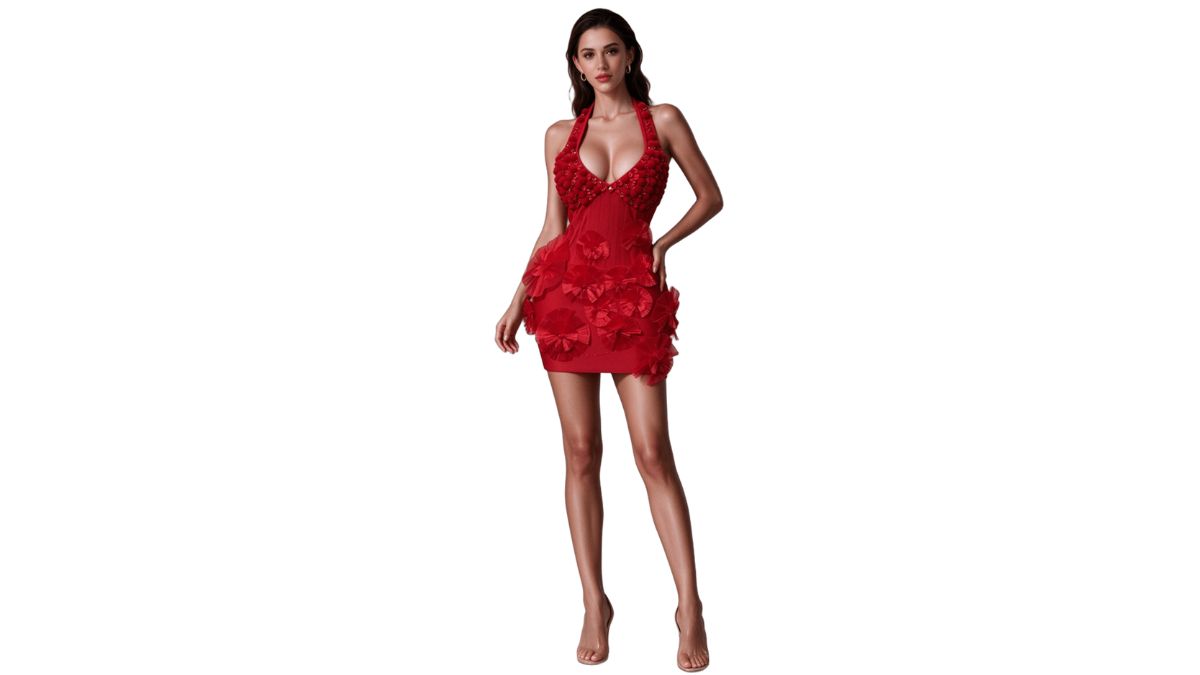
The sections below break down where exactly the visual trap occurs — camera, hanger, hand-feel, and coverage — and close with a weigh-up method any buyer can run on a sample.
Request a 10 cm × 10 cm swatch from every supplier quoting a lookalike style, and weigh it before accepting any GSM claim.
Camera, Hanger, and First Glance Hide Mass
The medium through which most sourcing decisions are made — the product photo — is the worst possible tool for judging fabric weight.
- Bandage dress photography for e-commerce stores flattens mass; a 220 gsm knit and a 360 gsm knit can share the same silhouette in a lookbook because the camera captures shape, not density.
- On a hanger, both hang as a tight column; the extra grams show up in the hand when the cloth is squeezed, not in the thumbnail when the image is scrolled.
- An expensive bandage dress often loses the argument in a side-by-side photo and wins it in a 10-second squeeze — the heavier cloth resists compression and springs back; the lighter cloth collapses and stays flat.
- "They look the same" is a GSM problem, not a styling problem; the solution is a weigh-up, not a longer look at the photo.
Hand-Feel, Drape, and Hold Are Where GSM Shows Up
The physical differences between a 220 gsm and a 360 gsm bandage knit are immediate and consistent once the cloth is handled.
- Higher GSM reads as luxurious weight in the hand: more body at the hip, less cling-and-collapse at the waist, and a resistance to stretching that communicates structure rather than fragility.
- A luxury bandage dress at 350–360 gsm has more yarn in each loop, so the cloth stands off the body instead of going papery — the sculpting effect comes from the mass of the knit, not from boning or lining.
- Lower GSM can still look tight in a still image and then read cheap after one wear because there is less mass to sculpt with; the garment stretches out and does not recover to the same silhouette.
- Compare hand-feel and elastic return after a pull; do not judge bandage clothing from the front-on photo alone, and do not accept a supplier’s verbal description of "heavy" without a weigh-up to confirm it.
Opacity and Coverage Rise With GSM Without Changing the Cut
More yarn per square meter closes the loop gaps in the knit structure, which reduces light transmission — and that property is invisible in a studio shot.
- More yarn per square meter closes the loop gaps in the knit structure, so light transmission falls as GSM rises; a 360 gsm cloth is meaningfully more opaque than a 200 gsm cloth cut to the same pattern.
- Two identical cuts can therefore look "the same dress" on a mannequin while only the heavier one stays decent in daylight — the lighter one may be sheer under direct light in a way that a studio photo with controlled lighting will never reveal.
- This is a GSM property of bandage dress fabric that applies to every color, not a white-only manufacturing concern; a navy or burgundy at 200 gsm can be just as sheer as a white at 200 gsm under the right lighting conditions.
- Buyers who skip the GSM number are often buying a see-through risk they cannot see in a studio shot; request a swatch and hold it to a light source before approving any sample.
A 10-by-10 Centimeter Swatch Test Any Buyer Can Run
The swatch weigh-up is the simplest, most reliable way to verify bandage dress quality without laboratory equipment.
- Cut a 10 cm × 10 cm square of the finished knit (0.01 m²), weigh it in grams on a precision scale, and multiply by 100 to get GSM — a 3.6 g swatch equals 360 gsm; a 2.2 g swatch equals 220 gsm.
- Compare that number to the PO; a 180 gsm result on a "360 gsm" quote is the 2× price gap in reverse — the buyer is being charged for heavy cloth and receiving light cloth.
- Keep a known 350–360 gsm mill card in the office so incoming sample lots have a physical baseline to compare against; the reference card makes the test faster and removes subjectivity.
- Run this test on heat-set cloth only — not on a stretched, steamed, or greige leftover, which will give a false reading because the mass-per-area relationship changes when the cloth is not in its finished, relaxed state.
GSM Spec Card for the Purchase Order
The table below gives buyers a one-page GSM card so a same-look dress cannot hide a half-weight knit — or a double-price quote — behind a photo.
| Spec | How to Write It | Fail Signal on a Sample |
|---|---|---|
| Finished GSM number | "360 gsm ± 10 gsm, finished and heat-set" | Swatch weigh-up returns a number more than 10% below the stated spec |
| Measurement state | "GSM measured on finished, heat-set cloth — not greige" | Supplier provides a greige weight that reads higher than the finished spec |
| 10 × 10 cm weigh-up method | "Buyer will cut a 10 cm × 10 cm swatch and multiply weight by 100 to verify GSM" | Supplier declines to provide a swatch for independent weighing |
| Piece weight range | "Finished piece weight for size M: 320–380 g" | Received garment weighs more than 15% below the stated range |
| Hand-feel reference | "Hand-feel and density to match approved 360 gsm reference card held by buyer" | Cloth collapses under light squeeze; no spring-back after stretch |
Include the GSM spec, the measurement state, and the weigh-up method as numbered lines on your wholesale bandage dress purchase order — not as notes or verbal agreements — so the spec is contractually enforceable.
Choosing a GSM Band for Brand Positioning
Fast-fashion thin knits and high-end heavy knits sit in different GSM bands; which band matches a brand is a positioning choice, not the GSM-to-price lesson in this article.
For a detailed thin-versus-heavy brand-positioning breakdown, see our dedicated article on PLT bandage dress quality vs. high-end.
Conclusion
Two bandage dresses can share a sketch and still be entirely different products; GSM is the weighable reason one can cost about twice the other.
The cost gap is real — it is built from yarn kilograms, knitting minutes, and finish load, all of which scale with fabric weight — and it is invisible in a photo, which is why buyers who skip the GSM number are the most exposed to it.
Fangbei produces bandage knit dress programs across the weight range covered in this article, including the viscose-route 360 gsm and polyester-blend 350 gsm examples cited above.
Before comparing FOB prices on any lookalike styles, request a finished-GSM ticket from each supplier, run the 10 × 10 cm swatch weigh-up on the sample, and confirm the spec in writing — or discuss your GSM requirements directly with our fabric and production team.