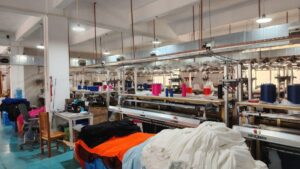
Walking an apparel exhibition aisle, every stand looks like a source.
Branded hangers, lit samples, and fluent English make a trading company look exactly like a bandage dress factory — until you ask the right questions.
The difference is not the fascia board. It is what the booth staff can say and show in the first three minutes.
A trading company poses as a bandage dress factory at exhibitions because true bandage knit is a niche process and booth presentation hides who owns the mill.
A real source factory can name yarn in, knitting, heat-set, cut, and sew as its own floors and connect a live feed from any of them during show hours.
A trader says "we can make it" without naming a building, a district, or a machine type.
Before you sit down for a long meeting, run the conversation tests in this guide.

The sections below give you a first-pass read of the stand, a live-video test you can run in sixty seconds, and a language scorecard that forces a trading company to show its hand before you leave the aisle.
Why Do Trading Companies Pose as a Bandage Dress Factory at Exhibitions?
Many expo stands look like mills.
Lights, racks, and fluent English make a trading company look like a bandage dress factory.
The difference is not the fascia.
It is what they can say and show in the first three minutes.
Trading companies pose as a bandage dress factory because true bandage knit is scarce and booth lighting hides who owns the mill.
A real source factory names yarn, knitting, heat-set, cut, and sew as its own floors.
A trader says "we can make it" without a building or machine type.
Use the first three minutes to read the stand before you sit.
Who greets you, how they describe the building, and whether they will live-video a floor already separate a mill from a trader.
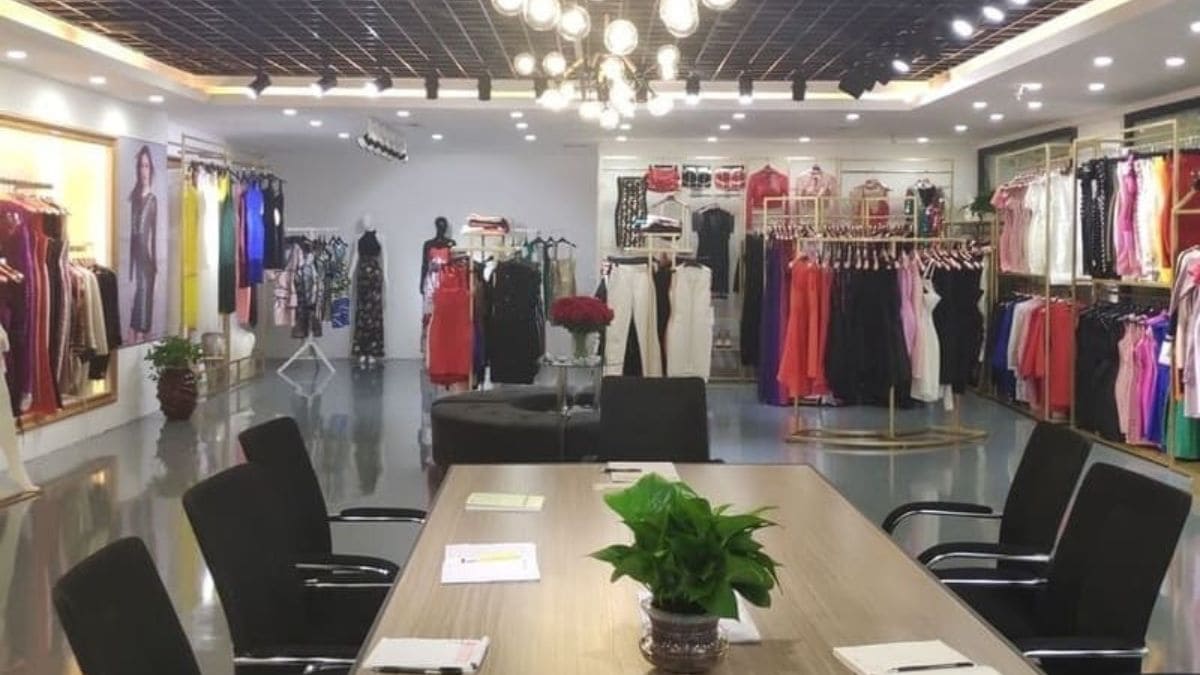
Why Bandage Clothing Attracts Middlemen on the Show Floor
True bandage knit is a niche process that requires circular knitting machines, heat-setting equipment, and a sewing line trained on elastic seams — most booths at a general apparel show do not own all of those floors.
- True bandage knit is a niche process, so many booths sell the look without owning a mill; a trading company can source finished bandage clothing from any of several Dongguan or Guangzhou manufacturers and present it as its own production.
- A trading company can hang a high quality bandage dress on a branded hanger and still be a reseller of someone else’s cut-and-sew; the dress does not carry a label that says "made by a middleman."
- Exhibition lighting and branded hangers hide whether the stand is a factory or a showroom; a well-lit booth with a logo wall reads the same whether the company owns knitting machines or only owns a trading license.
- Buyers who skip conversation tests book the nearest English speaker, not the source; the trader’s advantage is speed and fluency, not production capability.
What a Real Source Factory Controls That a Trader Cannot Name
Vertical control is a speech test — if they cannot place each step in a room, they do not run the room.
- A real bandage dress factory can name yarn in, knitting, heat-set, cut, and sew as its own floors — and can name the city, district, or industrial park where each step happens.
- A trader talks in "we can make" and "our partner factory" without a building address, a district name, or a machine type; the language is always one step removed from the production floor.
- Ask them to place each production step in a specific room or building; a source factory answers immediately, a trader pauses and generalizes.
- This is a conversation test, not a machine-history or QC-process audit; the only point is whether the person in front of you can claim each step as their own.
What You Lose When You Book a Trader Who Claims to Be the Maker
The risk is not just a higher price — it is a loss of control over every variable that matters after the show.
- Quotes change after the show because the trader is shopping your order to a third mill; the price you shook hands on is not the price the actual factory will accept.
- Fit, GSM, and zipper quality drift because the sewing floor is not the booth you shook hands with; the trader cannot enforce specs on a factory it does not own.
- Lead times slip when the hidden factory is already full; the trader cannot pull a production line it does not control, and "we will check with our factory" becomes a pattern, not a one-time delay.
- This is an identity risk at the stand — the question is whether you are speaking to the maker or to a reseller, not a wholesale-mistake checklist.
First Three Minutes at the Stand
The table below gives buyers a first-pass read of the booth before investing in a long meeting.
| What You Notice | Real Bandage Dress Factory | Trading Company Posing as Factory |
|---|---|---|
| Who greets you | A salesperson who can call a technician or supervisor within two minutes | Only English-speaking closers; no technical staff visible |
| How they describe the building | Names a city, district, and plant — "our Dongguan knitting and sewing facility" | Vague — "we have a factory" or "our production base" with no location |
| Whether they name knitting vs sewing | Distinguishes knitting floor, heat-set room, and sewing line as separate spaces | Talks about "production" as one undifferentiated step |
| Sample story they tell first | "This was knitted on our circular machines last month in [district]" | "This is our bestseller" — no production origin, no floor, no date |
| Comfort with a live workshop call | Offers to call the floor supervisor now or within minutes | Stalls, offers a USB drive, or says "after the show when our manager is free" |
Once you have read the stand in three minutes, the fastest confirmation is a live video call to the workshop floor.
Can a Real Bandage Dress Factory Live-Video the Workshop from the Booth?
The fastest identity test at a booth is not a catalog.
Ask the staff to live-video the knitting or sewing floor while you stand there.
A real bandage dress factory can reach a supervisor during show hours.
A trader stalls.
A real bandage dress factory can live-video a running knitting or sewing floor from the booth.
Ask them to pan to a bandage knitting machine.
Pre-edited films do not count.
If they stall, refuse, or cannot name computerized jacquard in plain terms, you are not speaking to the mill.
Score the call, the pan, and who answers when the question gets technical.
The scorecard below turns those three checks into a pass or walk you can run in one booth visit.
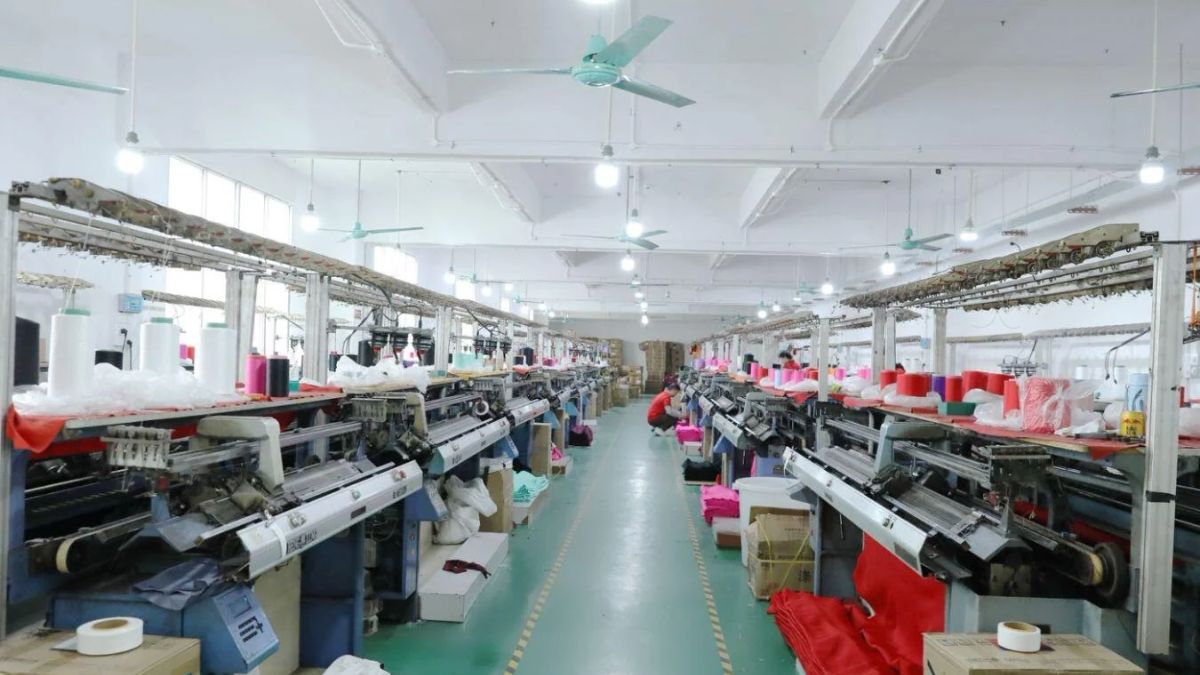
Asking for a Live Workshop Call While You Are Still at the Stand
The live-video request is the single fastest identity test available at an exhibition booth.
- Ask to FaceTime or WeChat-video the knitting or sewing floor now, not "after the show when our manager is free" — a real bandage dress factory runs shifts during show hours and can reach a floor supervisor within minutes.
- A real source factory can connect you to a running floor during show hours; a trader stalls, offers a USB drive with a pre-cut film, or shows a hotel-room sample presentation instead of a live feed.
- Pre-edited factory films do not count as a live-video test — the test is an unscripted, live feed from today’s shift, not a marketing video that could have been filmed at any facility at any time.
- If they refuse with "the workshop is confidential," treat that as a tell, not as professionalism; a genuine source factory has nothing to hide from a buyer who is about to place an order.
What Sixty Seconds of Live Feed Should Show
A sixty-second live feed from a real bandage dress factory is not hard to read.
- You should see running knitters or sewing lines with workers present, not a showroom rack, a logo wall, or an empty floor — an active shift has noise, movement, and shift lighting.
- Ask them to pan specifically to a bandage knitting machine or a heat-set and inspection area; this request makes it impossible to pass off a random garment shop as a bandage dress factory.
- Background noise, shift lighting, and a supervisor who answers questions in the local plant language are harder to fake than a poster or a pre-recorded clip.
- Keep this as a booth identity test; you are not running a post-show video audit or counting machines — you are confirming that a production floor exists and is running today.
Computerized Jacquard Knowledge as a Speech Test
Ask about computerized jacquard or circular knitters in plain language — not as a factory tour, but as a conversation.
- Ask what computerized jacquard or circular knitters they run for bandage clothing; a real maker names a machine type, describes a gauge or feed configuration, and connects it to band structure or fabric density.
- A real bandage dress manufacturer can explain in plain terms what a circular knitting machine does to band density or recovery — this is not specialist knowledge, it is the daily language of anyone who works on the production floor.
- A trader says "advanced imported machines" and pivots to catalog photos; the answer is always general, never specific, and always redirects away from the technical question.
- You are not asking for a knitting-machine history lesson; you are scoring whether the person in front of you has ever stood at a bandage knitting machine and understood what it was doing.
Who Answers When the Question Gets Technical
Watch the stand, not just the salesperson.
- Watch whether the English salesperson looks at a quiet technician standing nearby, or whether nobody on the stand can answer a technical question; a real bandage dress manufacturer usually brings at least one person who can talk yarn, knit, or sew.
- A trader brings only closers — people trained to handle price, delivery, and catalog questions, but not production questions; if every technical question produces a pause and a phone call, you are not speaking to the factory.
- If every technical question is answered with "I will ask the factory tonight," you are not speaking to the factory — you are speaking to someone who does not have direct access to the production floor.
- Record the name of whoever answered the technical questions; that person is who you follow up with after the show, not a generic sales inbox that routes to the same closers.
Technical Conversation Scorecard
| Booth Test | What You Say | Real Factory Response | Trader Response |
|---|---|---|---|
| Live workshop video right now | "Can you video-call your knitting or sewing floor now?" | Calls floor supervisor within minutes; live feed shows running machines | Stalls; offers USB or says "after the show" |
| Pan to knitting or heat-set | "Can you pan to a bandage knitting machine or heat-set area?" | Supervisor pans to running equipment; background noise audible | Feed cuts out, shows logo wall, or call is never made |
| Computerized jacquard / knitter type | "What circular knitters or computerized jacquard do you run for bandage clothing?" | Names machine type and connects it to band density or fabric structure | "Advanced imported machines" — no type, no gauge, no detail |
| Who owns the technical answer | Watch who answers when the question gets specific | Salesperson defers to a technician who is present at the stand | Salesperson answers alone; no technical staff visible |
| Offer of a pre-cut promo film instead of live feed | "I would prefer a live call, not a video file" | Accepts and makes the call | Insists the film is sufficient; cannot or will not connect live |
A stand that passes all five rows is worth a longer meeting; a stand that fails two or more rows is a trader, regardless of what the fascia says.
Which Conversation Details Separate Traders from Real Bandage Dress Makers?
Live video is one test.
Ownership language is the other.
Listen to how booth staff say "our factory," quote price, explain the sample, and name the plant.
Traders and real bandage dress makers do not speak the same way.
A real mill says "our knitting floor," names a district, and invoices from the gate entity.
A trading company says "we can arrange" and "confirm after production."
Ask who sewed the sample.
Mismatched stories, trading cards on a factory fascia, and "video after the show" are walk signals.
Use the red-flag lines below as copy-paste follow-ups.
Each one forces a trading company to show its hand before you leave the aisle with a business card you cannot trust.
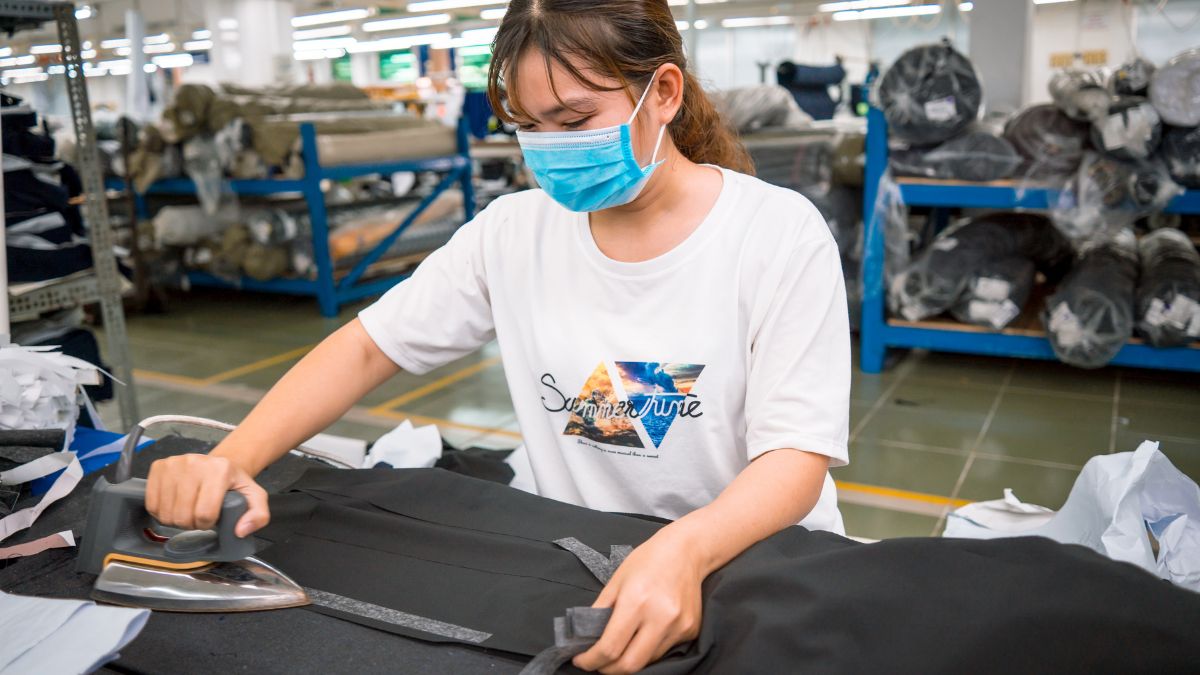
Ownership Language: "Our Factory" Versus "We Can Arrange"
Listen for the specific words they use when they describe production — the language gap between a mill and a trader is consistent and audible.
- Listen for "our knitting floor" and a district or industrial park name, not "we work with many factories for bandage dresses wholesale" — the second phrase is reseller language, not mill language.
- Ask who issues the commercial invoice and whose name is on the factory gate; traders often invoice from a trading company entity while the actual production happens at a separate legal entity the buyer never meets.
- A real bandage dress factory can name the legal entity that cuts the goods — not a brand name on a booth fascia, but the registered production company that employs the sewing workers.
- Repeat the same ownership question to a second person on the stand; if the two answers do not match — different city, different company name, different description of the building — that mismatch is a tell.
How Traders Talk About Price, Lead Time, and Quantity
A trader’s pricing language is fast and round because the trader has not yet spoken to the actual factory.
- Traders quote fast and round, then add "confirm after I check with production"; a source factory pauses before quoting because it is protecting a real production line with real constraints.
- Watch for "any quantity, any color, seven days" from a stand that cannot video a floor; that combination — unlimited flexibility with no production evidence — is reseller language, not mill language.
- A source mill will defend a sample lead time and a bulk production window because those windows belong to its own machines and its own sewing lines, not to a third party it has not yet contacted.
- Use quantity-and-time language as an identity tell, not as a buying tactic; the point is not to negotiate MOQ at the stand, it is to hear whether the answer sounds like someone who owns the machines.
Sample Origin Stories That Do Not Add Up
The sample on the hanger is the most direct evidence of who made it — if the story does not hold up, the stand is not the source.
- Ask which floor sewed the sample on the hanger and when it was made; a factory names a production line and a date, a trader names a courier or says "our supplier sent it."
- If every sample on the rack has a different hand-feel, a different weight, or a different seam finish, you are in a trading booth that aggregated samples from multiple mills — not a single source factory with a consistent production standard.
- Hangtags, size labels, and sewing thread that do not match across samples are conversation evidence; they suggest the samples came from different origins, which a source factory would not produce.
- Request one sample in a running mill shade they claim to knit; hesitation, a long pause, or "we need to check stock" is data — a mill that knits bandage clothing in-house knows its running colors immediately.
Place, Staff, and Card Details They Give Out Loud
The details a booth gives without being asked are often the most revealing.
- A real mill can name city, district, and a plant contact who is not the booth interpreter; "Dongguan, Houjie district, ask for the production manager" is a mill answer, "our factory is in Guangdong" is a trader answer.
- Business cards that say "import / export / trading" while the fascia says "factory" are a spoken contradiction; ask them to explain the difference between the card entity and the booth entity — a real mill has a clean answer, a trader does not.
- Staff who cannot describe yesterday’s shift, only this week’s catalog, are not production people; a sewing supervisor knows what was on the line yesterday, a trading company salesperson does not.
- You are scoring what they say at the stand, not running a license search — the formal credential audit comes after the show, once you have shortlisted a stand that passed the conversation tests.
Language Red-Flag Card
| What They Say | Likely Identity | Follow-Up Line to Use | Pass or Walk |
|---|---|---|---|
| "We can arrange any factory" | Trading company | "Which factory would cut this specific style, and what is their address?" | Walk |
| "Our partner handles production" | Trading company | "Can you call your partner right now and show me the floor on video?" | Walk if they stall |
| "Any MOQ, very fast" | Trading company | "What is your knitting machine capacity per week for this fabric weight?" | Walk if no specific answer |
| "Video after the show" | Trading company | "I need a live call now — can you reach your floor supervisor during show hours?" | Walk if refused |
| "This sample is from our other plant" with no plant name | Likely trading company | "What city and district is that plant in, and what is the legal entity name?" | Walk if no specific answer |
| Invoice entity different from booth name | Likely trading company | "Which entity will appear on the commercial invoice for my order?" | Verify before proceeding |
A stand that produces clean, specific answers to every follow-up line in this card is worth a longer conversation; a stand that deflects, generalizes, or changes the subject on two or more rows is a trader.
Formal Factory Credential Checks After You Leave the Booth
Conversation tests at the stand filter traders; a later credential check (license, planned video tour, machine count) confirms the mill you shortlisted.
For a detailed factory-credential verification guide, see our dedicated article on how to verify a bandage dress manufacturer in China.
Conclusion
At an exhibition, a real bandage dress factory can live-video a running floor, talk computerized jacquard or circular knitting in plain terms, and name its own invoice entity and plant district — a trading company posing as a source factory cannot do all three.
Run the live-video test and the ownership language scorecard at every stand before you invest in a long meeting, and walk any booth that stalls, generalizes, or produces mismatched stories.
Fangbei is a Dongguan source mill that can connect a live workshop feed from the booth and name its own knitting lines — explore our bandage dress production capabilities or reach our sourcing team directly to run these tests before your next show.